

The Distance Is Shrinking
What Relativity Space's Mars announcement reveals about the future of exploration
Relativity Space announced this week that it plans to launch a privately developed Mars science and telecommunications orbiter in 2028.
On its face, that's already notable.
The spacecraft will study the Martian atmosphere, map shallow subsurface ice, support communications, and carry advanced onboard computing capabilities. NASA Ames is contributing atmospheric science instruments. Relativity plans to launch the mission aboard its Terran R rocket. A philanthropic partner is reportedly helping fund the effort.
That's a compelling story.
But it's not the most interesting story.
The most interesting story is hiding in plain sight.
A Mars Mission That Isn't Really About Mars
Most people will read this announcement and see another Mars mission. And that's understandable. Mars has become the shorthand for ambition in space. For decades, we've measured progress by our ability to send increasingly sophisticated spacecraft to the Red Planet.
But if you spend a few minutes reading beyond the headlines, something else starts to emerge.
Relativity isn't just describing a science mission.
It's describing a future.
The company talks about high-bandwidth optical communications, radio-frequency relay services, massive onboard storage, server-class computing, autonomous operations, artificial intelligence models, and delay-tolerant networking. Taken individually, those sound like technical specifications. Taken together, they begin to suggest something much larger than a single spacecraft.
They suggest a future where Mars becomes more connected, more accessible, and more scientifically productive than ever before.
And that's where things get interesting.
The spacecraft is interesting. The emerging system behind it may be even more important.
For most of the Space Age, exploration has been mission-based.
We build a spacecraft. We send it somewhere. We collect data. We come home smarter.
That model has produced extraordinary achievements, from Viking to Curiosity to Perseverance. But what Relativity is describing hints at something different. Not a replacement for exploration, but the next layer built on top of it.
The Story Hidden Inside the Payload
The most intriguing part of this announcement isn't the orbiter's destination.
It's the role the spacecraft is designed to play.
The communications systems matter. The computing systems matter. The data relay capabilities matter. Not because those are exciting features in isolation, but because together they point toward a future where exploration becomes continuous rather than episodic.
For decades, Mars missions have largely operated as individual expeditions. A rover. An orbiter. A lander. Each accomplishing remarkable things, but often functioning as standalone efforts.
This announcement hints at a future where the systems supporting exploration become just as important as the explorers themselves.
Exploration changes when worlds become connected.
That may sound obvious, but it's worth pausing on.
Nobody gets excited about fiber optic cables. Nobody hangs posters celebrating telecommunications infrastructure. And yet infrastructure is what transforms isolated achievements into sustained progress.
Railroads changed continents. Undersea cables changed global communication. The internet changed nearly everything.
Not because the infrastructure itself was exciting, but because of everything it made possible afterward.
That's why I keep coming back to the communications and computing capabilities buried inside Relativity's announcement. The analogy isn't another rover. The analogy is an early internet node.
Not because Mars is becoming the internet. But because history tends to follow a familiar pattern: First come the explorers. Then come the systems that allow exploration to scale.
A New Model for Discovery
The announcement also hints at something else that deserves attention: a changing model for how science gets done.
For decades, planetary exploration has largely followed a familiar formula. Government agencies define the mission, fund the mission, oversee development, and operate the mission.
That model has delivered some of humanity's greatest scientific achievements.
But it is not the only model available.
Relativity's Interplanetary Sciences Program points toward something more collaborative. NASA contributes scientific expertise and instruments. Industry contributes transportation, operations, and infrastructure. Academic institutions contribute research. Philanthropic organizations contribute capital.
The result isn't the replacement of public science. It's potentially an expansion of it.
One phrase from Relativity's announcement jumped out at me more than any of the technical details: "A new model for public-private science collaboration."
That may ultimately prove to be one of the most important parts of the entire effort.
Because if exploration becomes less dependent on a single funding source or institutional pathway, entirely new categories of missions may become possible.
Why Narrative Matters
And that's where storytelling enters the conversation. Not because every company needs a better slogan. Because stories shape what people believe is possible.
Apollo was never really a story about rockets. The International Space Station was never really a story about orbital laboratories. Even the Mars rovers became cultural icons because they represented exploration itself rather than the instruments they carried.
The best space programs have always connected technical achievements to something larger.
Discovery. Exploration. Possibility. The future.
Without that context, even remarkable accomplishments can appear smaller than they really are.
That's why this announcement feels significant. Not because Relativity is sending a spacecraft to Mars. Mars missions are extraordinary, but they are no longer unimaginable.
What's exciting is the possibility that we're beginning to see the next phase.
A future where scientific discovery is supported by communications networks, advanced computing, commercial platforms, philanthropic investment, and public-private partnerships extending beyond Earth.
A future where exploration becomes more continuous. More connected. More capable. And perhaps more accessible.
The Distance Is Shrinking
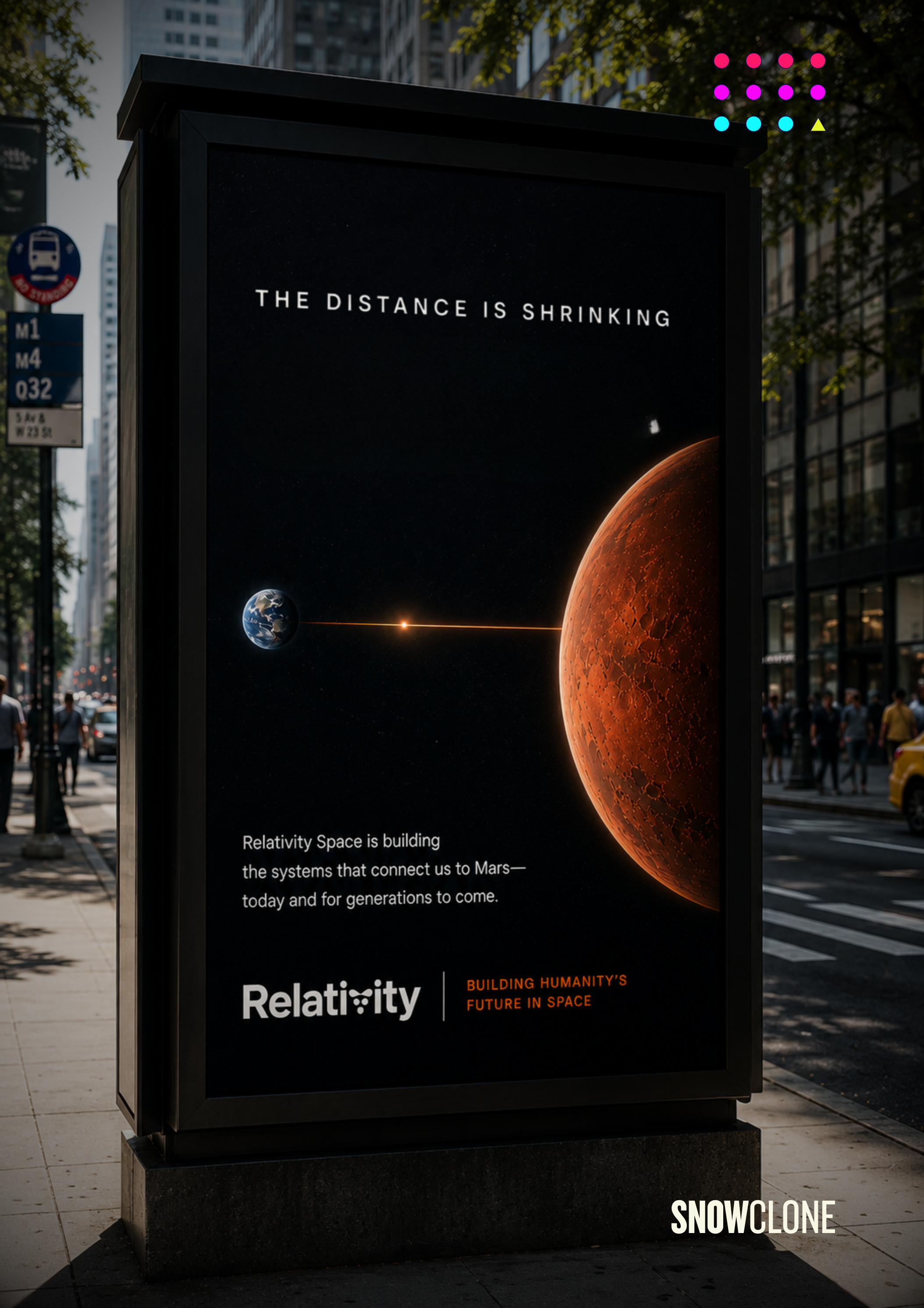
This isn't an actual Relativity Space advertisement. It's a concept we created after reading the announcement and asking a simple question: what if the story isn't just about getting to Mars, but about making Mars feel a little closer?
For most of human history, exploration has followed a familiar pattern. Someone crosses an ocean. Maps a coastline. Plants a flag. And eventually returns home.
The next chapter of space exploration may look different.
It may be defined not by our ability to reach distant worlds, but by our ability to remain connected to them.
That is what makes Relativity's announcement so interesting. Not simply that another spacecraft is heading toward Mars. But that we're beginning to see the outlines of something more permanent.
A future built on communications networks, computing platforms, scientific partnerships, and infrastructure extending millions of miles beyond Earth. A future where Mars is no longer just a destination. A future where Mars becomes part of the network.
And when that happens, the distance isn't really measured in miles anymore.
The distance is measured in how connected we are.
And by that measure, the distance is shrinking.
