

In Defense of the Em Dash, Our Most Emotionally Available Punctuation Mark
AI didn’t ruin the em dash. It just reminded us that punctuation without taste is punctuation without a pulse.
Apparently, the em dash is under investigation.
All over LinkedIn, people have decided that the sudden proliferation of em dashes is a tell. A giveaway. A smoking gun. Evidence that the writer has been leaning a little too hard on ChatGPT and hoping nobody notices.
And listen. I get it.
AI does love an em dash. It also loves saying things are “not just X, but Y.” It loves “unlocking potential.” It loves “navigating complexity.” It loves “the future of work,” “the pace of change,” and sentences that sound like they were pressure-washed by a B2B SaaS company.
But I need us to be very, very careful here.
Because some of us loved em dashes before the robots got their little digital hands on them.
Some of us have been using em dashes for years. Decades, even. Through good emails, bad drafts, crisis statements, launch copy, fundraising appeals, keynote remarks, floor speeches, late-night edits, and messages that had to persuade millions of people to care, click, donate, vote, show up, forward, RSVP, or just keep reading one more sentence.
I was a speechwriter. I have also written (a lot of) emails to millions of people. I think endlessly about writing and words and punctuation. Not in a cute “I like fonts” way (although, to be clear, I also like fonts. DM me on LinkedIn if you want my hot takes on Montserrat). I mean in a deeply annoying “I have strong feelings about rhythm, breath, emphasis, structure, cadence, friction, momentum, and whether this comma is doing anything useful” way.
And I am here to say:
The em dash is not the problem.
The em dash is a gift.
The em dash is a little trapdoor in a sentence. A tiny stage direction. A controlled interruption. A turn of the head. A hand on your arm before the speaker says, “Wait, this part matters.”
The em dash lets a sentence do what human thought actually does: swerve, double back, interrupt itself, add one more thing, change its mind, get funnier, get sharper, get more honest.
A comma is polite. A period is final. A colon is making an announcement while wearing a blazer.
But the em dash?
The em dash is leaning across the table with slightly too much intensity.
The em dash says: “Actually, there’s more.”
And isn’t that what writing is so often trying to do?
Not just inform, but persuade. Not just explain, but reveal. Not just move from Point A to Point B, but make the reader feel the turn in between.
This is where I must also defend the sacred art of the litany — the triplicate, the rhythm, the rhetorical pile-on. I mean, since we're already here.
Three examples in a row are not “AI writing.” They are how human beings have been making points since approximately the dawn of someone standing on a rock and trying to convince everyone else to follow them into a questionable battle.
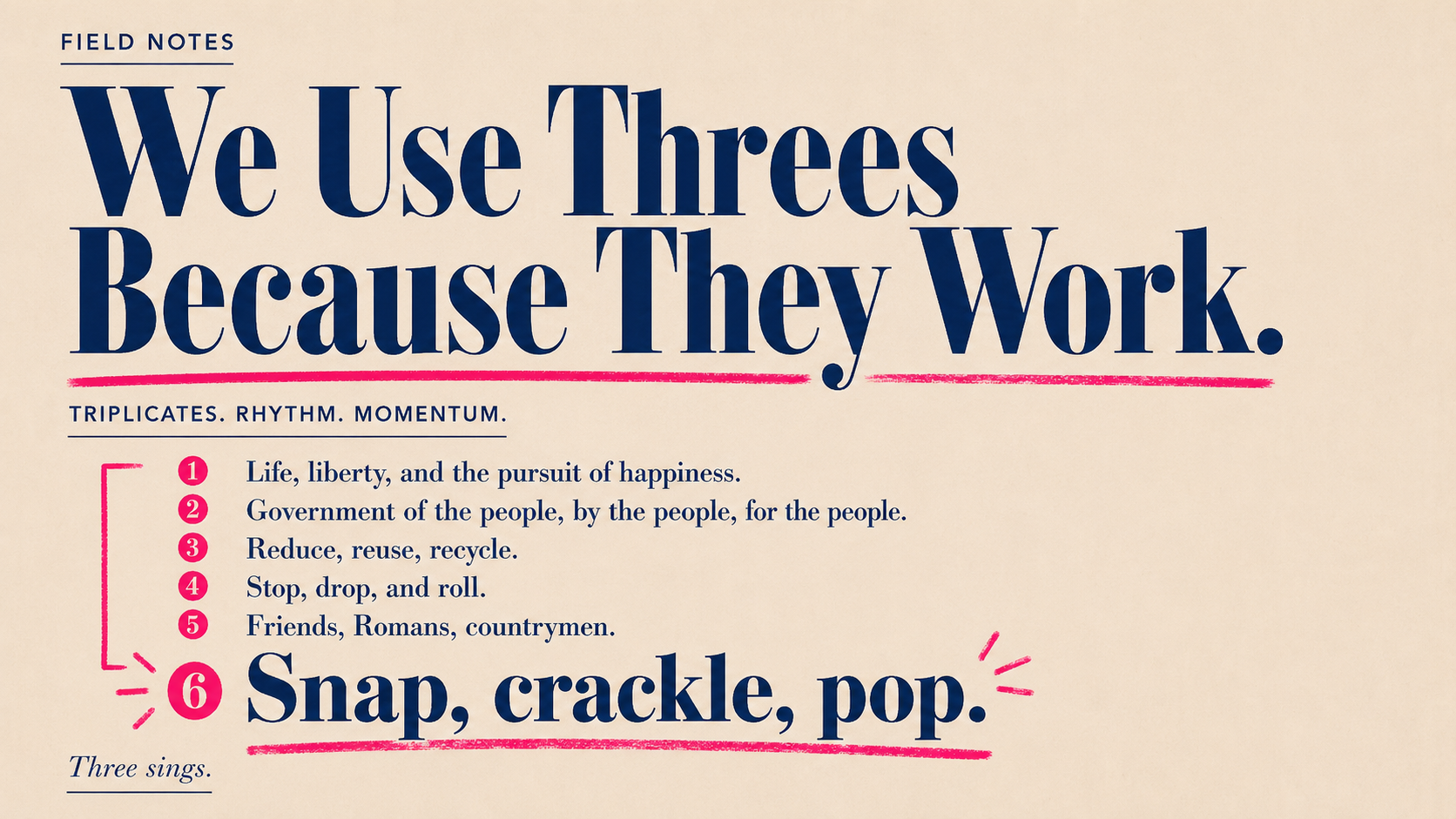
We use threes because they work.
Life, liberty, and the pursuit of happiness. Government of the people, by the people, for the people. Reduce, reuse, recycle. Stop, drop, and roll. Friends, Romans, countrymen. Snap, crackle, pop.
And yes, for the speechwriting sickos among us: “the work goes on, the cause endures, the hope still lives, and the dream shall never die.”
Technically four, sure. But Ted Kennedy was not up there at the 1980 Democratic Convention trying to optimize for LinkedIn discourse. He was building a wave. And sometimes the wave gets a fourth beat because the fourth beat is the one that knocks you flat.
Three is rhythm. Three is momentum. Three is structure your brain can hold onto while your heart is deciding whether to believe it.
Do I sometimes write in threes? Yes. Joyfully. Shamelessly. With the full confidence of someone who has spent enough time writing speeches to know that a good triplicate can save your life, your paragraph, and occasionally your boss.
Because sometimes one example is too thin. Two is too balanced. Four is a grocery list.
But three?
Three sings.
And then, yes, sometimes after the three beautiful little examples, I add an em dash — because I am a woman of taste, drama, and restraint except when restraint would make the sentence worse.
And this is not some new affectation I picked up from an AI tool.
In the early days of Indivisible, we embraced the em dash as part of the voice. Not formally, exactly. There was no punctuation strategy memo, although knowing us, there probably could have been (with a 6,000 word policy explainer and congressional call script). But it became part of the rhythm of how we sounded: urgent, human, slightly breathless, clear about the stakes, and allergic to sounding like a nonprofit had been left alone in a room with a whiteboard and too many values statements.
The em dash helped us write the way people talked when they were trying to make sense of a political emergency in real time.
It let us move fast without flattening everything. It let us sound serious without sounding dead. It let us carry outrage, clarity, urgency, and a tiny bit of chaos in the same sentence.
Which, frankly, was the assignment.
Now, could a writer overuse em dashes? Of course.
A person can overuse anything.
You can overuse exclamation points. You can overuse italics. You can overuse the word “ecosystem.” You can overuse “at the intersection of.” You can overuse “deeply,” “wildly,” “frankly,” “literally,” “transformational,” “bespoke,” and “the new normal,” which should have been sealed in concrete and dropped into the ocean sometime around 2021 by Tony Soprano and at least two guys named Sal.
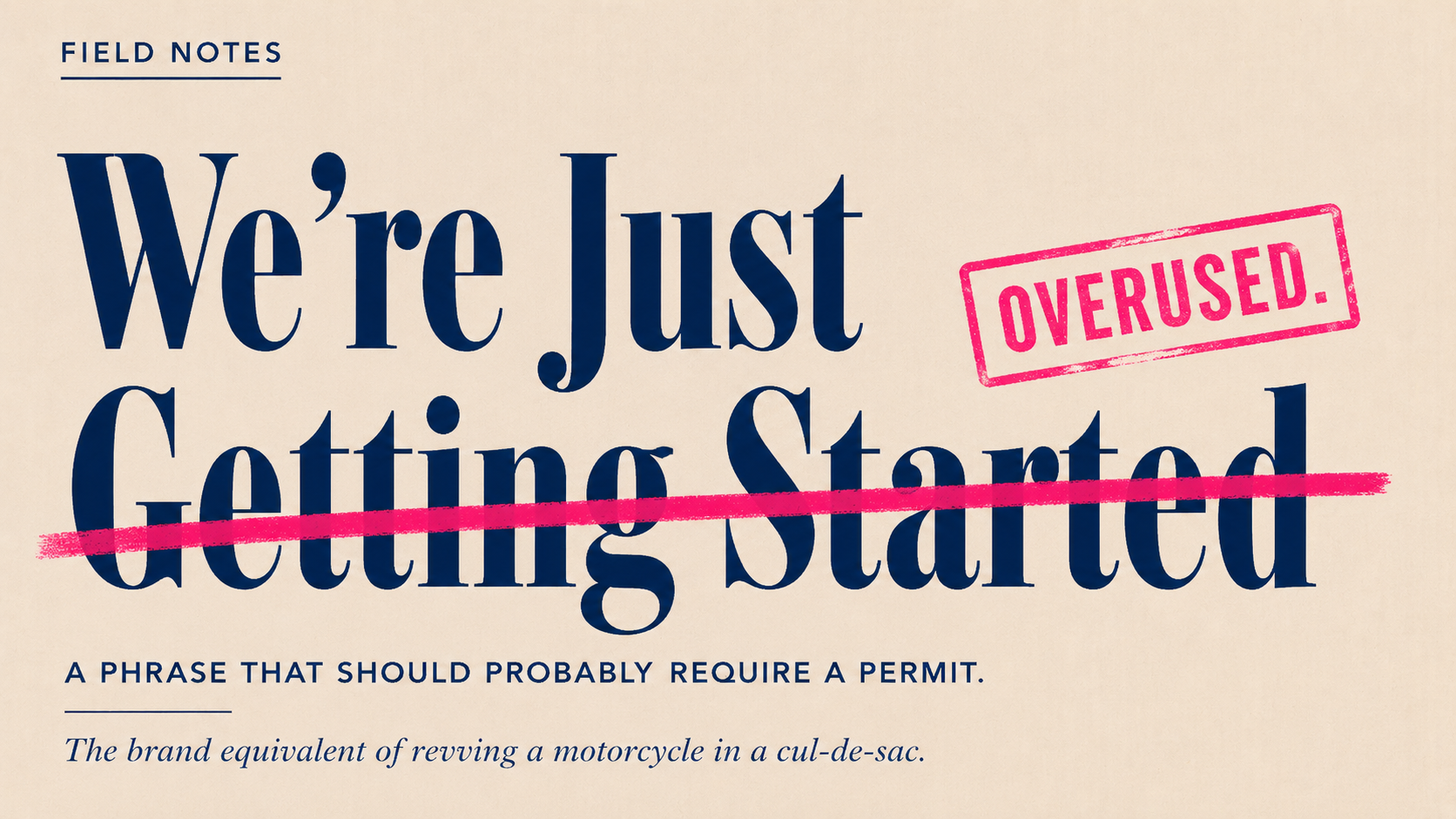
You can also overuse “we’re just getting started,” a phrase that Ezra Levin — my former colleague, co-founder of Indivisible, and one of my favorite humans — once effectively outlawed because, in addition to being overused, it always sounds like the brand equivalent of revving a motorcycle in a cul-de-sac.
Every organization wants to say “we’re just getting started.” Very few organizations should be allowed to say it. Some are, in fact, quite far along and should consider getting to the point. Hard stop.
You can also overuse semicolons, though that tends to be less of an AI tell and more of a sign that someone went to grad school and has not fully recovered.
The semicolon is fine. I respect it. I even admire it in certain habitats.
But let’s be honest: the semicolon always feels like it is trying to get tenure.
The em dash, by contrast, has places to be.
It is agile. It is useful. It understands the assignment. It creates suspense without making everyone sit through a quarterly planning meeting about it.
The problem is not that AI uses em dashes.
The problem is that AI often uses them without taste.
It uses them where there should be a cleaner sentence. It uses them to fake rhythm. It uses them to create the illusion of insight. It uses them the way a hotel lobby uses a fiddle-leaf fig: to suggest intentionality where there may not be any.
But bad use of a good tool does not make the tool bad.
AI also uses paragraphs. Should we stop using those? It uses bullet points. Should consultants be rounded up and forced to communicate only through interpretive dance? AI uses phrases like “in today’s fast-paced world,” and yet somehow we have not banned the word “today,” though frankly I am open to that discussion.
The truth is that there is no punctuation mark that can launder bad thinking into good writing. Not the em dash. Not the semicolon. Not the colon. Not the Oxford comma, though I do believe the Oxford comma is morally correct and I will not be taking questions at this time.
What makes writing sound like AI is not punctuation.
It is vagueness. It is sameness. It is the absence of a real human mind making real choices.
That is the actual giveaway.
Not the em dash.
The giveaway is when a paragraph sounds like it has been sanded down to remove all fingerprints. When every sentence is technically fine and spiritually dead. When the writing gestures toward meaning without ever risking specificity. When there is no voice, no point of view, no heat, no weirdness, no scar tissue, no delight.
And this is the thing I keep coming back to in the age of AI: the tool is not the voice.
AI can help you get unstuck. It can help you move faster. It can help you find the shape of an idea, test a frame, generate a first pass, make the blank page less accusatory. I use it. I like it. I am not standing in the woods yelling at electricity.
But AI cannot replace the human part of writing.
It cannot know what you actually mean. It cannot feel when a sentence is too smooth. It cannot hear the tiny little death rattle of a phrase that sounds fine but says nothing.
And the funniest proof point may be coming from the AI companies themselves.
Anthropic — the company behind Claude, the AI many people use specifically because it is good with language — has been hiring human writers and copy leaders for very real salaries with very real commas in them. Business Insider reported that Anthropic posted a copy lead role with a salary range of $255,000 to $320,000, and a head of copy/content role up to $400,000.
The people building the machines still understand that voice, narrative, taste, judgment, and meaning do not magically appear because someone fed a prompt into a box and asked it to “make it more compelling.”
Even the world’s biggest AI companies know there is a difference between generating language and knowing what language is for.
That is the part organizations need to understand. Especially tech companies. Especially frontier tech companies. Especially the ones currently trapped inside a website template made entirely of blue gradients, floating particles, abstract mesh blobs, glowing orbs, vague promises, and the phrase “transforming the future” arranged over a hero image that looks like a screensaver that just secured some venture funding.
You know the sites I mean. They all look expensive. They all sound confident. They all say almost nothing.
It is carbon-copy nothingness. High-production nothingness. Nothingness with a navy-to-cobalt gradient and a tasteful animation delay.
And this matters because when every company sounds the same, no company sounds credible. When every homepage promises to “accelerate innovation,” “unlock value,” and “shape what’s next,” the reader does not think, “Wow, what a visionary organization.”
The reader thinks, “Okay, but what do you do?”
Or worse, they think nothing at all.
That is where a human has to come in.
A human has to touch it. Mess it up a little. Put fingerprints back on it. Add the joke that is maybe too specific. Kill the sentence that is technically perfect but emotionally beige. Replace “drive meaningful impact” with literally anything else. Ask whether the thing sounds like a person or like a conference badge gained sentience and started posting on LinkedIn.
Because the future of writing is not “no AI.”
It is not “all AI,” either.
It is AI plus judgment. AI plus taste. AI plus a human being who knows when to leave in the weird little turn that makes the sentence breathe.
Or, to put it another way: AI can give you words. A human gives you the moment.
That is the part I still care about most. The moment where a sentence stops being functional and becomes memorable. The moment where rhythm carries the idea farther than explanation could. The moment where the right phrase makes the reader sit up a little straighter.
It’s Sam Seaborn from The West Wing in 20 Hours in America, Part II, somehow finding the language for Bartlet after a pipe bomb explodes at Kennison State University.
The speech names the assault. It names evil. It names the students who heard the explosion from their practice facility and “ran into the fire.”
Ran. Into. The. Fire.
And then comes the line every speechwriter, future speechwriter, political kid, Sorkin obsessive, and emotionally overinvested watcher remembers: “The streets of heaven are too crowded with angels tonight.”
Now, to be extremely clear: a website landing page about quantum computing is not a presidential address after a fictional university bombing. A LinkedIn post about space commercialization is not a national moment of mourning. Nobody needs a Series A founder to write like he is standing under the portico with a Marine band behind him.
Please do not make your “About Us” page sound like the republic is ending.
But startup CEOs asking ChatGPT to write their next quote, homepage, investor blurb, product launch post, or “we are thrilled to announce” paragraph could still learn something from that scene.
Not the grandeur. Not the sentimentality. Not the full Sorkin orchestral swell.
The lesson is that language has a job.
It has to meet the moment. It has to know what the audience needs to feel, understand, believe, or do next. It has to carry the right amount of weight. It has to sound like it came from someone who knows why the words matter.
That is public language doing what public language is supposed to do: helping people metabolize meaning without flattening it into a statement.
It is Bartlet delivering the line Sam found. It’s Sam knowing what the moment needed. It is Aaron Sorkin reminding every kid sitting at home dreaming of writing a speech like that for someone important enough to be listened to that words can still matter — not as decoration, not as theater, but as a way to steady a room when the room has lost its footing.
AI can imitate the shape of that.
But it cannot know why it works.
Not really.
And yes, sometimes the human being who does know why it works will add an em dash.
Maybe two.
Maybe an amount that makes LinkedIn men in quarter-zips start muttering darkly about “tells.”
So be it.
Human writing has fingerprints. It has preferences. It has grudges. It has habits. It has little obsessions. It has a rhythm you can recognize in a dark alley.
For me, that rhythm often includes an em dash. Because sometimes I want a sentence to pivot. Sometimes I want it to punch. Sometimes I want it to pause dramatically in the doorway, turn back, and say the thing it should have said three clauses ago.
That is not AI.
That is years of writing under deadline. Years of trying to make institutional language sound like it came from a living person. Years of taking the mushy, the bureaucratic, the over-approved, the legally terrified, the committee-blessed, and trying to smuggle a pulse back into it.
So no, I will not be surrendering the em dash because LinkedIn has decided it belongs to the machines now.
The machines can have “leverage.” They can have “game-changing.” They can have “seamless integration.”
They cannot have my em dash.
They did not earn it.
The em dash was there for me in campaign war rooms, in speech drafts, in national email programs, in launch copy, in crisis comms, in sentences that needed room to breathe and sentences that needed a little knife hidden in the boot.
It was there when a comma was too weak. It was there when a period was too cold. It was there when parentheses felt like whispering and I needed the sentence to kick open the door.
So by all means, let’s get better at spotting AI writing. Let’s call out the mush. Let’s challenge the clichés. Let’s stop pretending that “elevate your brand narrative” means anything unless you can explain what, exactly, is being elevated, from where, to whom, and why anyone should care.
But let’s not blame the em dash for showing up to work.
The em dash is innocent.
The em dash is useful.
The em dash is ours.
And if loving it makes me suspicious, so be it.
I have been accused of worse things — including, but not limited to, caring too much about a sentence.
