
The Most Important Thing About Quantinuum's IPO Has Nothing to Do With Quantum
Quantinuum's public debut reveals a challenge facing every frontier technology company: the science is advancing faster than the story
On Wednesday, Quantinuum begins trading as a public company.
That's a milestone for the company.
It's also a milestone for the quantum industry.
For decades, quantum computing has occupied a strange place in the public imagination. To scientists, engineers, and researchers, it represents one of the most important technological pursuits of our time. To everyone else, it has often felt like a distant promise—something perpetually five or ten years away, wrapped in technical language that seems designed to keep outsiders at arm's length.
That may be starting to change.
Because public markets have a way of forcing technologies to explain themselves.
And that's what makes Quantinuum's IPO so interesting.
The company isn't just testing whether public markets are ready for a quantum company. Public markets are testing whether quantum companies are ready for public markets.
Those are not necessarily the same thing.
For years, quantum companies have largely communicated with researchers, physicists, government agencies, and specialized enterprise customers. Their audiences understood terms like logical qubits, fidelity, fault tolerance, quantum volume, and error correction.
Public markets are different.
Public markets include investors, journalists, policymakers, students, business leaders, and ordinary people trying to understand what comes next. And that audience isn't asking how quantum computing works. It's asking why quantum computing matters.
We’ve spent the better part of the last several years around the quantum industry through our work with Quantum World Congress, the Potomac Quantum Innovation Center, and conversations with researchers, founders, investors, government leaders, and the companies helping build what many believe will become the next great computing platform.
One thing I've noticed is that quantum has no shortage of brilliant people. What it sometimes lacks is translation.
The science is advancing faster than the story. And increasingly, that story matters.
The Industry Has Become Very Good at Explaining the Machine
Spend enough time around quantum and you'll start to notice a pattern.
Many companies are remarkably effective at explaining their technology.
They can tell you about trapped ions and neutral atoms. About coherence times and gate fidelities. About architectures, roadmaps, error correction schemes, and scaling strategies.
These are important conversations.
They matter enormously.
Without them, none of this happens.
But they're often conversations about the machine.
The broader world is interested in something else: Consequences.
Nobody wakes up wanting a quantum computer. They wake up wanting better medicine. Cheaper energy. More secure communications. Stronger economies. Scientific breakthroughs. Competitive advantage.
The machine matters. But the machine is not the destination. It's the vehicle.
And sometimes the industry becomes so focused on explaining the vehicle that it forgets to explain where we're all supposed to be going.
The Story Is the Consequence
That's why I've always thought quantum companies face a unique communications challenge.
The technology itself is remarkable, but the most important thing about it isn't the technology. It's what the technology makes possible.
Take drug discovery.
One of the most promising applications of quantum computing is helping researchers better understand the behavior of molecules—something that remains extraordinarily difficult for conventional computers. The long-term promise isn't a more impressive computer. It's faster paths to new medicines, treatments, and therapies that don't exist today.
Or consider materials science.
Human history is filled with examples of new materials creating entirely new eras of economic progress. Bronze. Steel. Semiconductors. Batteries. Quantum computing may eventually help researchers discover and model new materials in ways that are impossible today, accelerating breakthroughs in manufacturing, energy, transportation, and countless other industries.
Then there's cybersecurity.
One of Quantinuum's commercial products, Quantum Origin, uses quantum-generated randomness to strengthen digital security. Most people will never care about quantum random number generation—and they shouldn't have to. What they care about is trust. They care about protecting financial transactions, critical infrastructure, healthcare systems, and communications in an increasingly digital world.
The pattern is the same in every case. The quantum computer isn't the story. The story is what happens because the quantum computer exists. That's where the industry's greatest opportunity may lie. Because while quantum companies have become exceptionally good at explaining the machine, the broader world is still waiting for more companies to explain the future the machine is intended to create.
Quantinuum Is Actually a Good Example
To be clear, this isn't really a critique of Quantinuum.
In many ways, they're ahead of much of the industry.
Long before quantum became a mainstream conversation, Quantinuum was investing in ecosystem building, thought leadership, partnerships, and public engagement. They understood something many technology companies eventually discover: Breakthrough technologies don't become transformative when scientists believe in them. They become transformative when society believes in them.
That's part of what makes today's IPO so significant.
Not because it proves quantum computing has arrived. And not because every technical challenge has been solved. But because it represents a transition from a field that has primarily been speaking to itself to one that increasingly needs to speak to everyone else.
The Quantum Industry Is Entering Its Clarity Premium Era
This is why Quantinuum's IPO feels larger than a single company.
It represents a transition.
For years, quantum computing existed primarily as a scientific endeavor. Today, it is increasingly becoming an economic one. Capital is flowing into the sector. Governments are making strategic investments. Corporations are building roadmaps. Universities are training workforces. Public markets are beginning to pay attention.
As that happens, a new competitive advantage begins to emerge.
Clarity. Not hype. Not oversimplification. The ability to explain extraordinarily complex technologies in ways that remain accurate while becoming understandable.
The organizations that master that skill will recruit talent more effectively. They'll attract investment more easily. They'll build partnerships faster. They'll shape policy conversations more successfully. They'll create trust more quickly.
In other words, clarity becomes a force multiplier. Not because it replaces technical excellence. Because it amplifies it.
A Thought Experiment
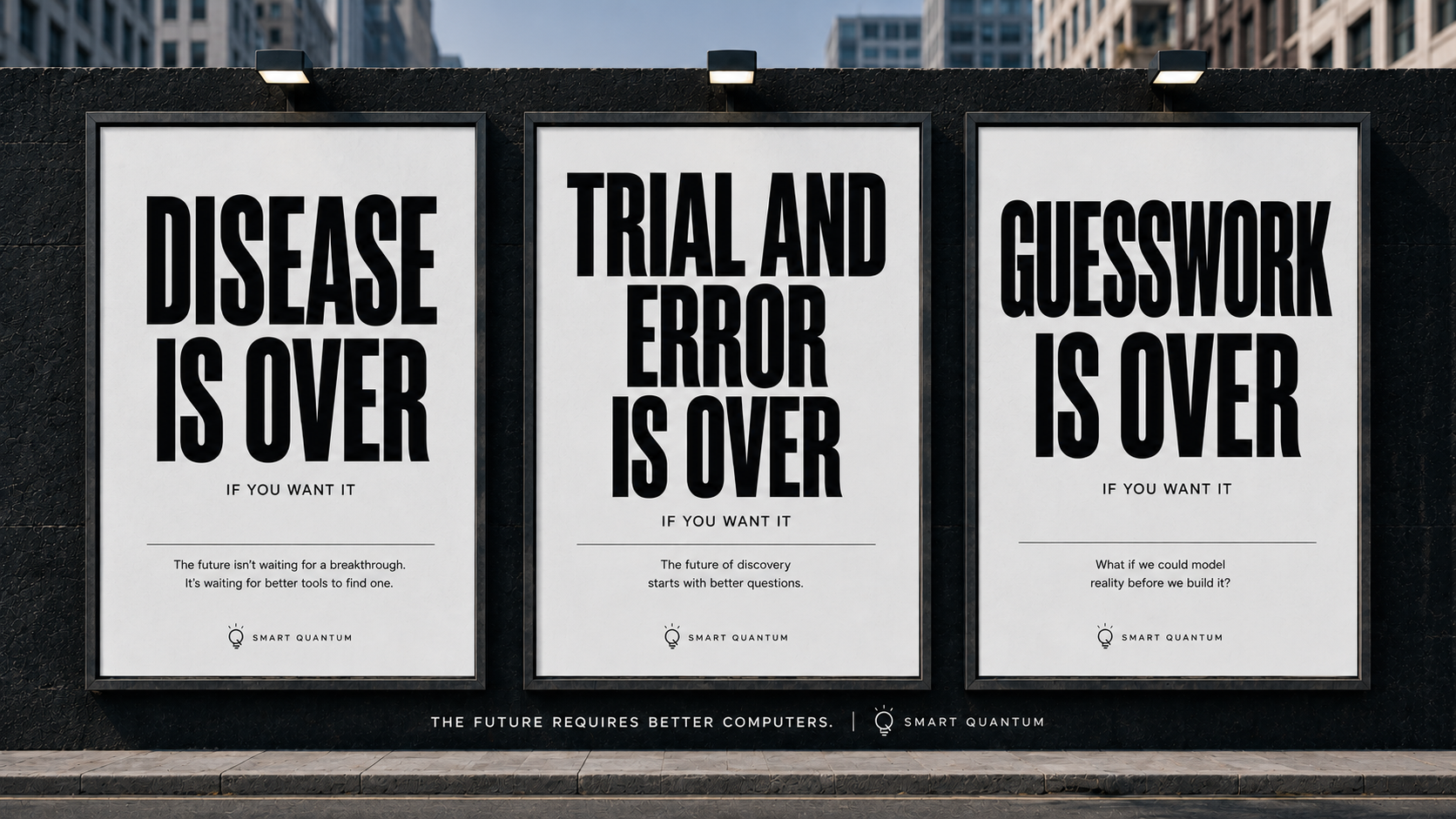
What would happen if a quantum company stopped advertising the machine and started advertising the future?
The speculative concepts below are not affiliated with Quantinuum or any other quantum company (but should be). They’re illustrate the kind of narrative shift I believe many frontier technology companies will eventually make.
They're loosely inspired by John Lennon and Yoko Ono's famous "WAR IS OVER! (If You Want It)" campaign, which launched in 1969.
The campaign wasn't successful because it described reality.
The Vietnam War was still raging. People were still dying. The phrase was obviously untrue in a literal sense. That’s precisely why it worked. It wasn't a statement about the present. It was a statement about the future. A provocation. A challenge. An invitation to imagine a world that did not yet exist.
More than fifty years later, the phrase remains instantly recognizable—not because it advertised a product or explained a policy proposal, but because it communicated a possibility.
That's the power of outcome-driven storytelling.
People rarely rally around a technology. They rally around what that technology might make possible.
The concepts below ask a simple question: What if quantum companies advertised the future instead of the machine?
The Next Phase of Quantum Will Be Won Outside the Quantum Industry
For decades, the primary challenge facing quantum computing was proving the science. Today, the science is increasingly proving itself.
The next challenge is helping the rest of the world understand what that science makes possible.
That's why Quantinuum's IPO matters. Not because it settles every question about the future of quantum computing. Not because it guarantees success. But because it marks a transition. Quantum is leaving the laboratory. It's entering markets. It's entering boardrooms. It's entering public conversation. And increasingly, it will be judged not only by its ability to advance the science, but by its ability to help society understand why that science matters.
The future of quantum computing will certainly be shaped by better hardware, better software, and better algorithms.
But it may be shaped just as much by something else: The companies that can help people see the future before it arrives.
Because ultimately, the most valuable thing a frontier technology company can build isn't a machine. It's belief.
